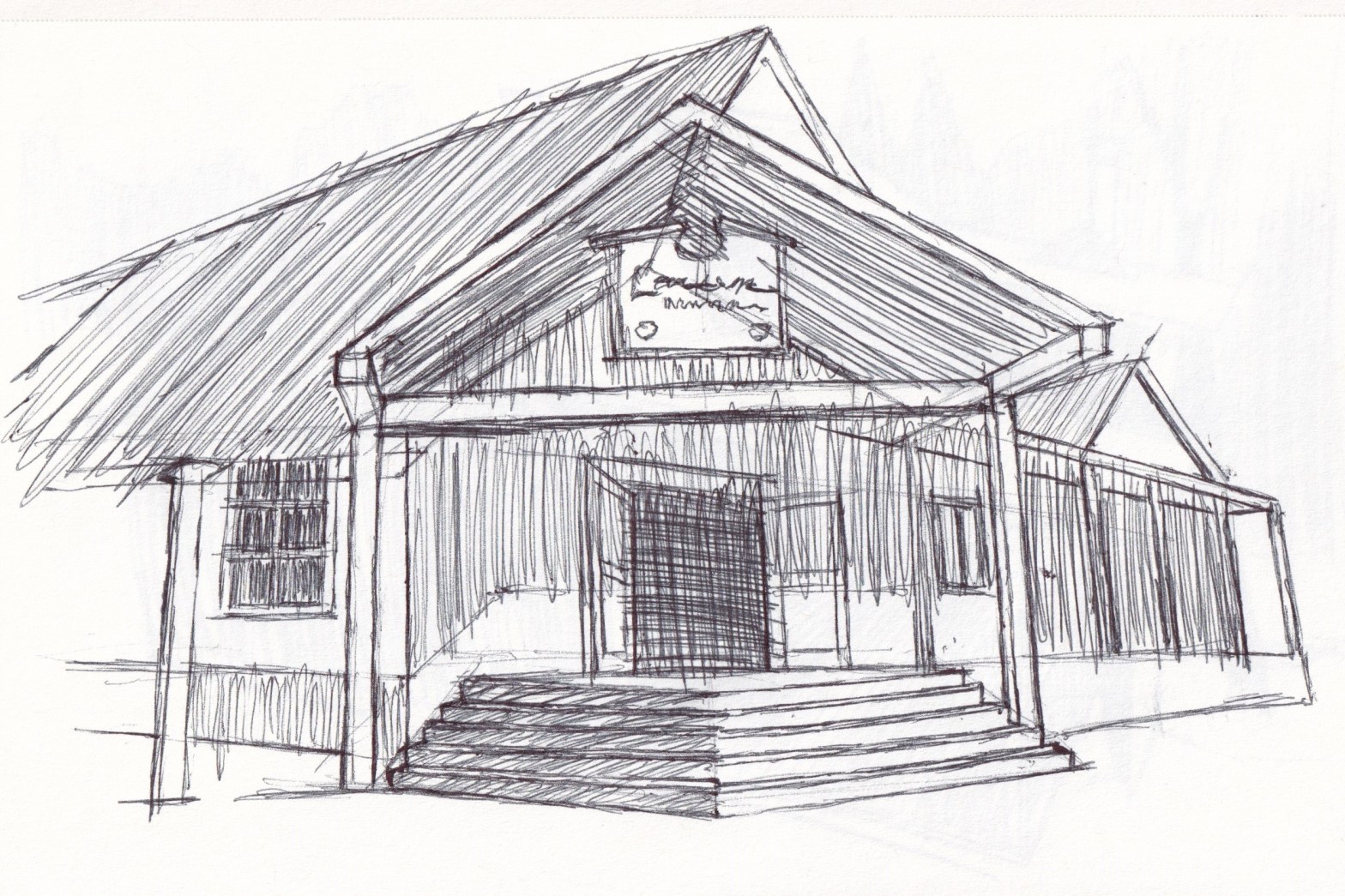
The rolling behemoth that would have flattened me flashes past in my rearview mirror. If only my other issues were equally avoidable. Life is seldom as simple as the pictures that we paint.
I’ve been asking myself, “How did I get here?” for a while, now. Maybe I should explain where the question originated. If I say that I hate to be the center of attention, you have a right to wonder, “Then why is he writing a memoir?” It isn’t in keeping with my character. As stated in my online profile, I’m “usually, the quietest guy in the room.” In that case, what accounts for my devotion of so many words to myself? The answer lies where my art and declining health intersect.
Late in 2018, I began experiencing a shoulder problem. Because of it, I could no longer lift my right arm very high. After navigating through occupational services, physical therapy and workers’ compensation as it was attributed to overuse on the job, it delivered me to the office of an orthopedist. When the steroid injection that he gave me failed to fix the poor control that had, I believed, resulted from what he called a case of frozen shoulder (adhesive capsulitis), the doctor said he could only restore my range of motion. He blamed any loss of dexterity on my Parkinson’s. Although said as if it were obvious, I hadn’t ever considered the possibility before and was stunned (his assistant had claimed, while leading me into the little room where I got the news, that I looked like I had thought that I was being taken hostage so I must have known that it was serious).
What I encountered isn’t uncommon. Dopamine is a neurotransmitter. It sends signals through your nervous system to your muscles. A regular flow of the stuff keeps your movements smooth. A shortage results in rigidity. Joints are prone to “freezing up.” It’s how a lot of people learn that they have the disease.
A couple of weeks after hearing the glib practitioner’s observation, passing the verdict along to management and failing to cite a reason whenever they would ask me, “Why are you still here?” I took personal leave from the printing plant where I had been employed. In September of 2019, a three-month wait to see a neurologist later, the truth was not only confirmed but suggested to be even worse than I had imagined. The expert in the field told me, following our twenty-minute conversation, that I had yet to blink my eyes. It indicated that I was afflicted with something more aggressive: Parkinson’s Plus. Several conditions actually fit underneath that generic-sounding umbrella. I consulted the internet and discovered that cortico-basal degeneration (CBD), specifically, involved a slow blink rate. Not to worry, I told my registered-nurse-sister on the phone: it would only last four to six years. After she had done some research of her own, she informed me that I wouldn’t last any longer than my condition. I couldn’t say when exactly the clock had started ticking but was sure, as soon as I hung up with her, that time was running out.
I rushed to finish a final creative project, dealt with the disability carrier and wrestled with the ethics of accepting an idle life (I was ashamed to stay at home until, early in 2020, a pandemic forced a few of our neighbors into a similar boat). To fill the hours and catalog my art, I organized a website. Once a painter reaches a certain age, a retrospective is staged to record his or her accomplishments. I couldn’t wait. As a consequence, I became my own biographer. Although I chose the domain name, colinturnerswork.com, as a way to maintain a professional level of decorum (and since other Colin Turners had already claimed the easier iterations), it went beyond collecting whatever images remained. A blog was a part of the WordPress package that I had purchased. It hosted, before too long, one post after another delving into my past. Thirty or so eventually summarized how I had gotten where I was.
The problem arose where the platform was social. Like other interactive media, people are free to react to your contributions (or not, as I experienced). Why had two bloggers appreciated what I had composed today when, yesterday, three had? You compare yourself to those with thousands of followers, scroll down, read the myriad remarks on their pages and wonder why you’re such a clod. You even alter your message to gain a wider audience.
Art, even so, isn’t a popularity contest. True innovation happens whether public opinion is swayed or not. Van Gogh died penniless, after all.
Given how stultifying my online involvement had become, I decided to disconnect my introspection from the internet. Anyway, its initial urgency had dwindled as a different timeline had developed. An MRI had revealed nothing abnormal about my brain (as it would have with CBD; it did, however, speak volumes about my behavior; I had practically fallen asleep inside of the loud machine with a plastic cage attached to the backboard tightly immobilizing my head). In addition to that encouraging result, I responded well to the medication used to treat run-of-the-mill Parkinson’s (also, as I would not have with CBD). The drug can’t delay the disease but does improve some of the symptoms and wouldn’t have worked unless I had lowered dopamine levels (which isn’t the case with CBD, either).
To return to March of 2022, the guy that claimed the I wouldn’t move for an oncoming train shared another piece of wisdom, “People don’t die from Parkinson’s; they die with it.” Of course, I had already expected a longer lifespan than I would have with CBD. Until hearing it stated so succinctly, though, I hadn’t considered starting a lengthier project. Instead of focusing on occasionally posting on a blog, why not write a memoir now that I had the time to finish it? As I added to the introductory message on the website homepage before I abandoned it, “My story isn’t over.”
 Colin Turner's Work