On the short drive from Davis into Sacramento, California, there’s a noteworthy sign. After crossing a three-mile-long viaduct (called the Yolo Causeway) over a floodplain that fills up and feels like the Florida Keys in the wetter season, two highways split. The lanes on the right are dedicated to Interstate 80. They sweep around to an overpass and disappear to the left. If you maintain your previous heading, however, you read “50 East to Ocean City, MD, 3,073 miles” on a marker atop a pair of posts. How often have I passed it and wondered about the length of road connecting –– or almost –– one distant coast to another. That pavement is, after reaching Nevada, designated, “the loneliest road in America” but I’ve never been that far.
Originating in the fertile valley at the heart of one of the largest economies in the world, the route traverses a river. Cresting the bridge, you’re afforded a view into the capitol city. A paddle-wheeler, the Delta King, is moored along its waterfront (sea-faring cargo ships are docked to the southwest in its inland port; their passage along a narrow channel making them look like mechanical monsters roaming the farmland). Soon, the road ascends into the Sierra foothills while entering El Dorado County, where I grew up.
Rescue, what I consider my hometown, sits on the western slope of the famous range. Although technically a part of the neighboring hamlet of Shingle Springs, the house into which my family moved on my sixth birthday in 1976 was located at Route 2 Box 993K, Rescue, California and only later reassigned when the post office got involved. Our country lane had needed a name. My parents had wanted “Rocky Top” yet the neighbors at the bottom of the driveway had objected to us –– underhandedly? –– glorifying our property alone. As a bland alternative, “Rural” was adopted.
Our gravel led to the busier thoroughfare where the school bus would pick us up and drop us off again (my two sisters were four and six years ahead of me so we rarely waited together at the shack built to shelter kids from the rain; it faced away from the road so that we had to watch for the arrival of our ride through a knot-hole in the siding). I would disembark that communal, yellow mode of transportation at the end of my academic day and hike upward to our perch in the pine trees. Something about the pavement always represented the wider world. On a bicycle, logging trucks and drastic elevation changes made pedaling difficult into the nearest town (Rescue had a single, later abandoned general store that drew me there on occasion). I dreamt of how, with a motorized means of escape, a continent’s worth of exploration –– after so many interchanges, exits and various surfaces streets –– waited wherever the highway eventually went.
Despite how a dizzying web of asphalt offered endless stretches of opportunity, once I had turned sixteen, I travelled amazingly seldom, myself. From an early age, I would always enjoy a journey if I got dragged along. As a licensed driver, though, I was more commonly content to stay at home. Again I wonder whether ambivalence or apathy rendered me nearly immobile. With the former conflicted and the latter lazy, the dilemma that kept me parked in the path of a hypothetical locomotive in my fifties had already posed a motivational issue for me as a teenager.
By 2011, a shakeup was overdue. Lisa changed everything. We met in our early forties after having moved to the Medford, Oregon area separately many years earlier: she from a few hundred miles north and me from a similar distance south. That I hailed from a county that included Lake Tahoe’s lower shore prompted her curiosity. Although it was only an hour-and-a-half away from where I had wasted a lot of my youth, the fact that I was unfamiliar with the nearby region remained. How could I not have ventured over there on occasion? I couldn’t explain except to say that I hadn’t ever considered the trip worth the trouble.
Our very different temperaments worsened how lethargic I looked to her. Lisa, by contrast, is either gifted or cursed with a surplus of energy. Medication helps her to cope with a chemical imbalance. Symptomatic of her disorder, she craves action. It took her to Nepal once, in her thirties, on her own; although she didn’t summit Everest, I found her attempt amazing.
How unalike are she and I? In our case, opposites actually did attract. To me, it’s simple. We complement each other. She gets me out of the house and I keep her grounded.
Her endearing habit of photographing our frequent adventures, in addition, has inundated our computer hard drive with thousands of images. Since early in our relationship, we have relied on a Subaru Crosstrek as our ticket to follow the open road (my California relations cite its stigma –– the manufacturer gratefully acknowledges how the lesbian community gave them a foothold in America –– but Oregonians see the brand as affordably rugged and little else). Although only a handful of miles old when it left the dealership, we have rolled the odometer into the low six-digit-territory with our tendency to randomly roam on our weekends and time off from work. Given her penchant to snap pictures along the way, my passenger and I (her documentary urges are contagious) have amassed a visual archive from which I can now draw inspiration.
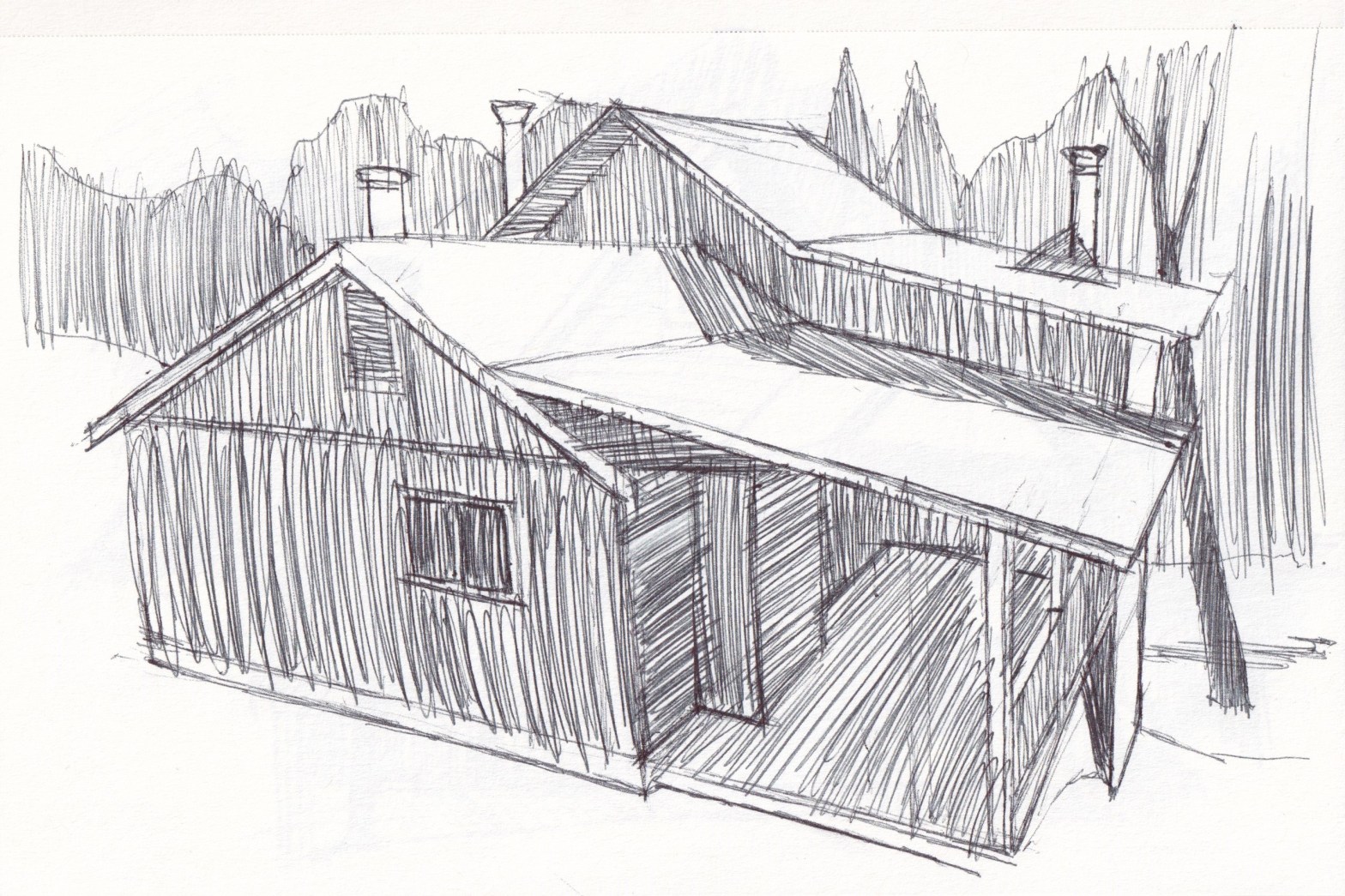
At home, we use an extra bedroom as an office and a studio. There’s an art table and a desk opposite each other. Where I sit depends on whether I need the monitor or not. The screen is stationed where I can relocate a keyboard to practice sketching (an ample surface remains with the obstacle removed). Whatever memories are conjured onto the broad display, they occupy me for hours. Over a decade’s worth of records are instantly available. The technology is stunning. I’m always in awe of how the exhaustively chronicled data is stored on our CPU, easily retrievable and arranged to show feats of free-wheeling recreation that would have seemed unthinkable little more than a century ago.
That’s roughly how long the automobile has redefined an era. Car culture has spread to such a degree that we take a pleasant drive for granted. Distances spanned in hours used to require days. Although air travel is superior for getting you further far more quickly, the modern age’s ultimate transportation is immeasurably more complicated, also. With the hassle and expense involved, I’m hardly a frequent flyer (Lisa’s mom and stepdad, after hearing my diagnosis, had organized a trip to Italy for the four of us; it was supposed to have happened in March of 2020, a pandemic postponed our timeline and the death of our dear matriarch ruined our chances, altogether, as a family). After touchdown, you would typically board a bus or get a rental, anyway. Thusly, the pavement awaits your return. As an immersive experience, you could do better by walking or riding a bicycle –– my dad pedaled from Boston to San Francisco to celebrate turning fifty; I can’t imagine a closer look at your surroundings –– but, unless you’re an athlete, a motorized overland tour will likely have to suffice. So that’s how I reminisce about our lives. We, as a couple, haven’t traveled widely, by any means. Still, Lisa and I have obeyed our now-mutual wanderlust on a regular basis. We always strive for the rush of a new discovery just around every bend or familiar corner. A perusal of our computer files would depict, to a viewer who wasn’t aware that dull workweeks had divided our days off, a continuous series of forays into a more expansive field. In reality, we either stay in Oregon or go to California –– I have a complex relationship with the latter –– but our journeys into the past transcend our geographical limitations.
 Colin Turner's Work